hero default image
When was the last time you had a good, deep dialogue?
You know, the kind that makes you change your mind about things, maybe even moves the needle of your heart?
The kind that didn’t offer a neat, harmonious solution but, instead, opened up the possibility of multiple ways of knowing and being in the world?
Don’t be surprised if it takes you a beat or three to remember such a conversation – or if you don’t recall one at all.
And if you do recall one, chances are that it might have been as challenging as it was exhilarating. As much as we have become aware of the multiplicity of perspectives and voices in the world, the cultural norm has, of late, tended to push us into echo chambers and camps of like-minded peers – a trend facilitated by social media and affirmed by recent research.
It’s a trend that our churches are no stranger to, either. Consider the denominational (and political) schisms of the past decades or Hartford Institute’s latest data showing that the apparent resurgence in church attendance post-pandemic has been instead a recalibration, favoring larger churches.
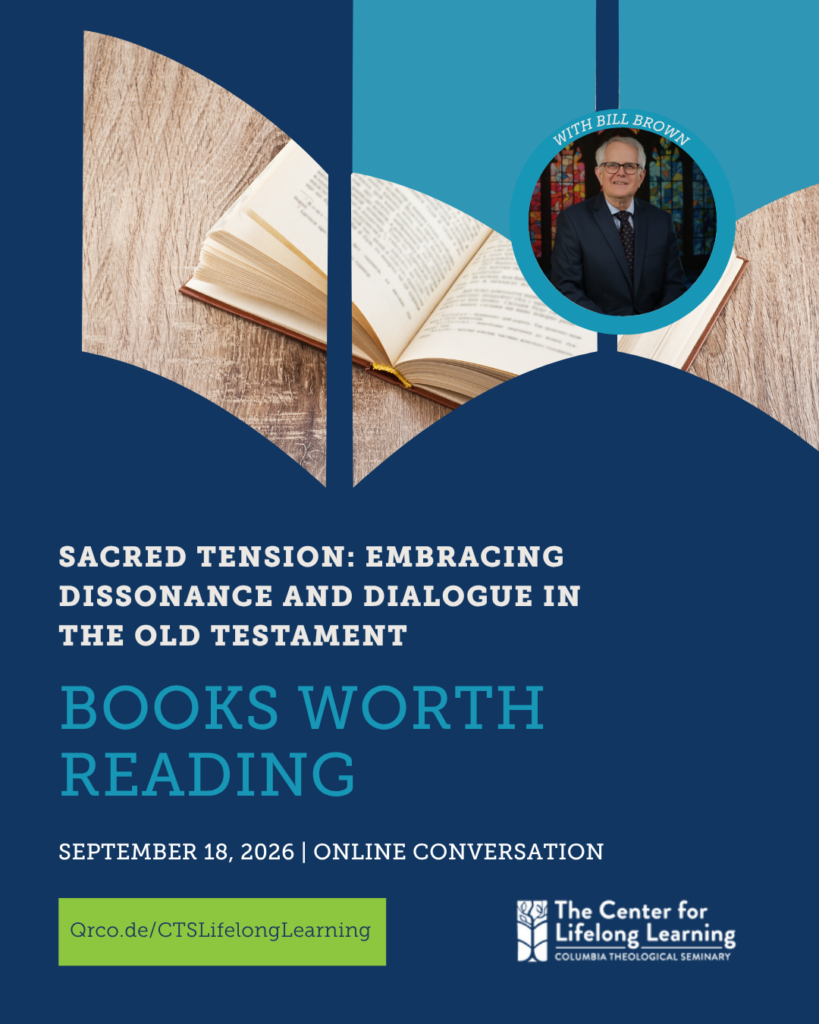
In the middle of this trend comes the most recent book by Bill Brown, Columbia’s William Marcellus McPheeters Professor Emeritus of Old Testament; Sacred Tension: Embracing Dissonance and Dialogue in the Old Testament.
The Bible, he argues, is “no echo chamber, endlessly repeating the same thing over and over again.” Instead, it is a “canonical cornucopia,” defying passive engagement or lazy interpretation.
It is filled with apparent contradictions and diverse perspectives, knitted together by the common thread affirming that God is God. Its dissonance, he argues, is not a problem – it is its strength, inviting participants into rich dialogue that interrogates, wonders, affirms, and challenges any single narrative line or simple answer to complex questions.
There are multiple creation accounts and versions of the Decalogue; Wisdom literature simultaneously pronounces the promise of a good life for the righteous while also admitting that the wicked live in prosperity. By including diverse and discordant voices, the canon reminds us that the faithful life is marked more, perhaps, by authentic engagement across difference rather than sure and uniform answers.
The Bible is many things. “Efficient” is not one of them. Nor is it “univocal.” But the vision of God’s shalom demands nothing less than this.
I return to the opening question. When was the last time you participated in dialogue that mirrors what we find in scripture itself?
And is that approach reflected in how you lead, preach, and teach? As Brown says, “The Bible talks to us and is meant to get us talking with each other, not at, to, or against each other.”
This, he says, is what cultivates true community – the heart of the work we are called to do.
Interested in a deeper dive into Brown’s book? Join us for our first Books Worth Reading conversation, online – Fri. Sept. 18!
Helen Blier, Ph.D. serves as Associate Dean of the Center for Lifelong Learning at Columbia Theological Seminary and also as the president of the Association of Leaders in Lifelong Learning for Ministry (ALLLM).

